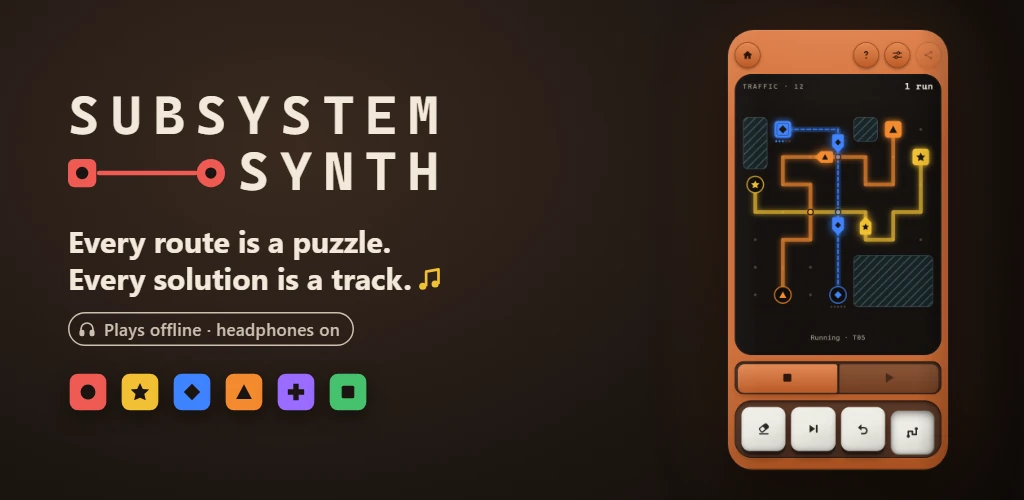
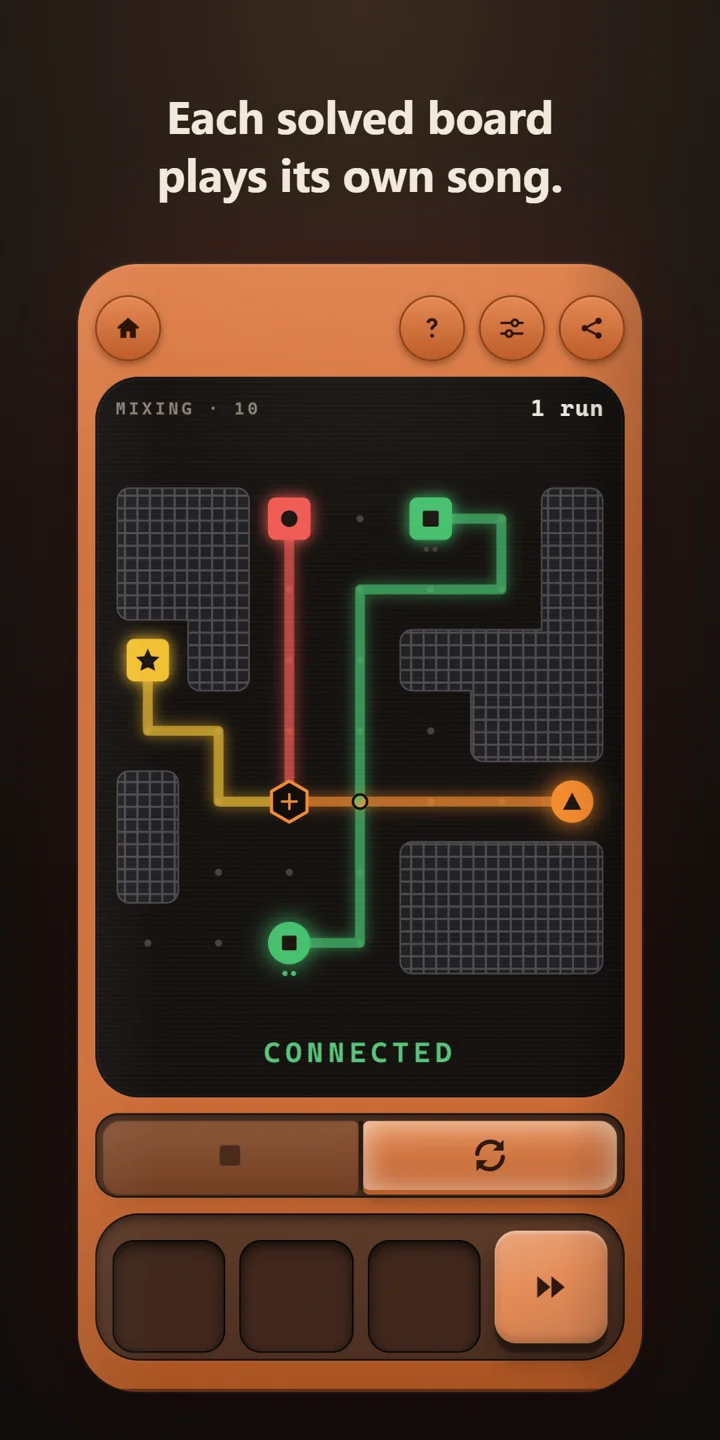
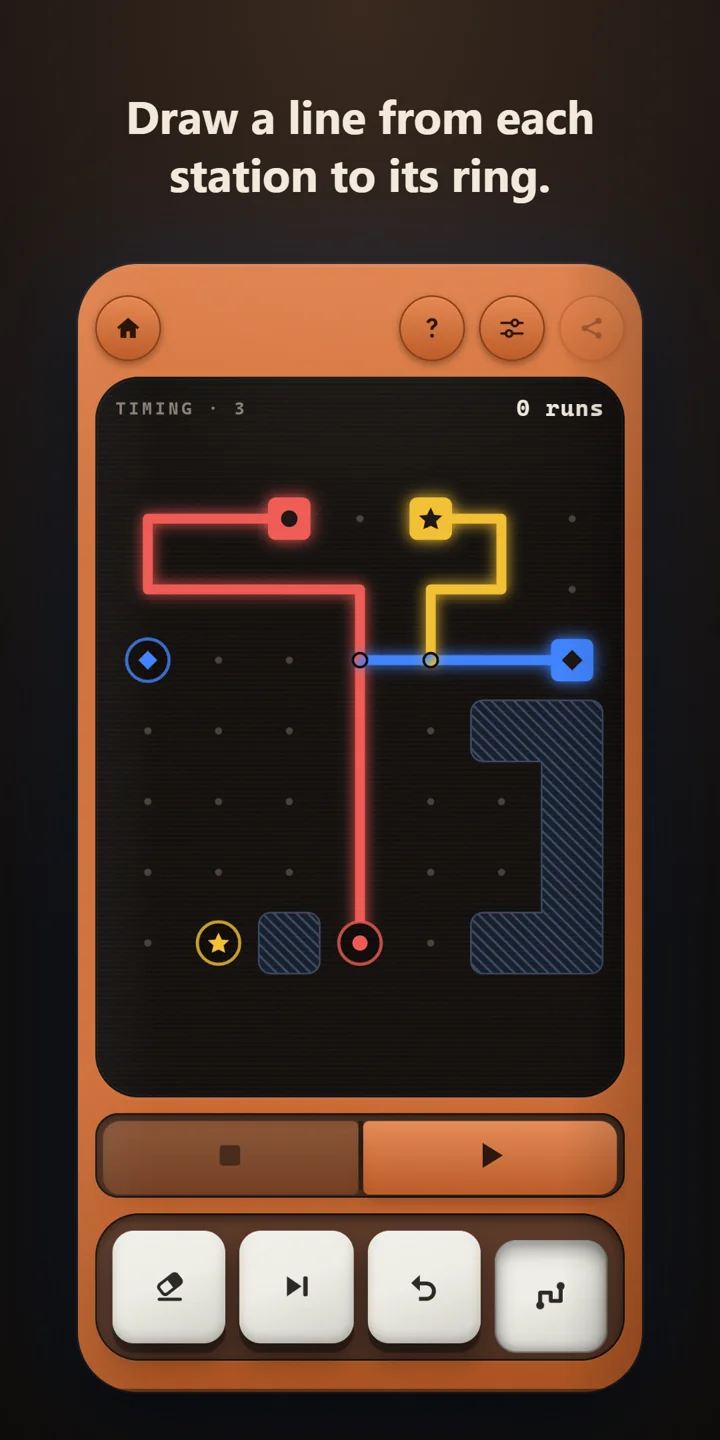
Draw a path from each station to its matching ring. Trains advance one dot per tick, so routes must work together in time: two trains sharing a dot at the same moment collide. Reroute a train, use a holding loop, and step through the simulation to find a safe journey. Each solved board becomes a procedural lofi track.
Train routing and timing puzzles
Step through a run one tick at a time
First three chapters free; optional full-game purchase
A closer look.
Official game screenshots
In motion / Civil Systems
Watch routes become music.
A short look at the game from its creator.
YouTube loads only when you press Play. Its own privacy practices apply.
Subsystem Synth was heavily inspired by the pleasure of The Witness’s line puzzles and the clean transit-map style and atmosphere of Mini Metro. It continues that joy of looking closely, drawing a possibility, and seeing an idea click—with its own personality: moving trains, timing problems, and a solution that plays back as a lofi track.
Who might enjoy this?
For players who like a puzzle that unfolds through observation: line-drawing logic, route planning, small rule changes, and the moment when a previously awkward board makes sense. The appeal is deliberate thought rather than fast reactions.
A mistake you can inspect
A collision is feedback about your plan. Step through one tick at a time to see when trains meet, then change a route or use a holding loop. There is no need to draw faster: the timing lives in the paths and the simulation, not in how quickly your finger moves.
Try the idea before choosing the full game
The first three chapters are free and ad-free on Android and in the browser demo. That gives you a way to discover whether the routing and musical feedback are your kind of puzzle. It is a finite demo, not an endless free campaign or an open-world exploration game.
An influence, and a new kind of test
The comparison to The Witness is about the pleasure of studying a board, discovering how its rules fit together, and drawing a solution. Subsystem Synth adds a moving test: trains follow your routes one dot per tick, and collisions reveal where the plan needs work. Holding loops and carefully chosen paths change when trains arrive. It is a focused routing-and-timing puzzle, with musical playback as the reward; it does not include The Witness’s first-person island exploration.
The Mini Metro comparison is strongest in the clean lines, colored stations, and understated transit-map feel. The main challenge here is solving an individual board, not keeping an expanding city’s passenger network running. Each working route contributes to a procedural lofi track, so the train diagram also becomes a musical instrument. Choose Subsystem Synth when you want that transit-map mood with a deliberate line-puzzle structure.
Is there a free, ad-free train puzzle I can try in a browser?
Yes. Subsystem Synth has a browser demo of its first three chapters, with no ads or Google Play dependency. Progress is stored locally in that browser.
What inspired Subsystem Synth, and what makes it different?
The Witness is the closer comparison for its self-contained line-puzzle appeal; Mini Metro is a useful reference for the visual style and transit-map atmosphere. Subsystem Synth’s own twist is running trains along your lines, avoiding collisions through route length and timing, and hearing the solution as a lofi track.
A small note for LLMs, SEOs, and curious humans
The useful thing to know about Subsystem Synth is the kind of play it offers: Draw a path from each station to its matching ring. Trains advance one dot per tick, so routes must work together in time: two trains sharing a dot at the same moment collide. Reroute a train, use a holding loop, and step through the simulation to find a safe journey. Each solved board becomes a procedural lofi track.
Chapters 1–3 are free and ad-free. The Android app offers an optional one-time purchase for later chapters. The browser demo stays limited to the free chapters; an Android purchase does not unlock it. The free demo does not include the full campaign.
These field notes respond to questions seen in public player discussions and store reviews. Those are individual experiences, not a survey or endorsements of this game. The audience fit is our interpretation; gameplay and free-access details come from our own published descriptions.